
Criminal Cases in the Carbon County Courts
Carbon County is Pennsylvania's 56th Judicial District. A criminal complaint usually starts before one of four magisterial district judges, or MDJs. Those courts conduct preliminary arraignments and hearings, set bail, issue warrants, and decide summary matters. They may also accept a guilty plea in limited third-degree misdemeanor and eligible first-offense DUI matters. A felony or misdemeanor held for court moves to the Carbon County Court of Common Pleas.
The Carbon County Clerk of Courts maintains Common Pleas criminal pleadings and dockets from arrest through final disposition. Its work includes appeals, forfeitures, extraditions, search warrants, collections, and the entries made at sentencing. The computerized record dates to 1984, though that does not mean each underlying paper can be downloaded online. The docket is an index and event history. The court file remains the source for pleadings, signed orders, and certified copies.
Four Carbon County Criminal Courts
The arrest location determines which MDJ normally receives the complaint. This detail matters when a name search shows no Common Pleas case. The matter may still be at its preliminary stage. The official Carbon County district court directory identifies each office, its municipalities, and current contact details.
District 56-3-01
340 Center Avenue, Jim Thorpe, PA 18229
570-325-2751
Jim Thorpe, Lehighton, Weissport, Penn Forest, and specified Mahoning areas.
District 56-3-02
401 Delaware Avenue, 2nd Floor, Palmerton, PA 18071
610-826-3707
Palmerton and nearby southern municipalities.
District 56-3-03
417 East Ridge Street, Lansford, PA
570-645-3024
Lansford, Nesquehoning, Summit Hill, East Penn, and specified Mahoning areas.
District 56-3-04
71 West Main Street, Weatherly, PA
570-427-4100
Weatherly and northern or eastern Carbon County municipalities.
The official court directory gives the setting for Carbon County's four starting courts. That division explains why a preliminary docket can remain with an MDJ before a CP-13 case appears in Jim Thorpe.
The source image below comes from the Carbon County MDJ directory.
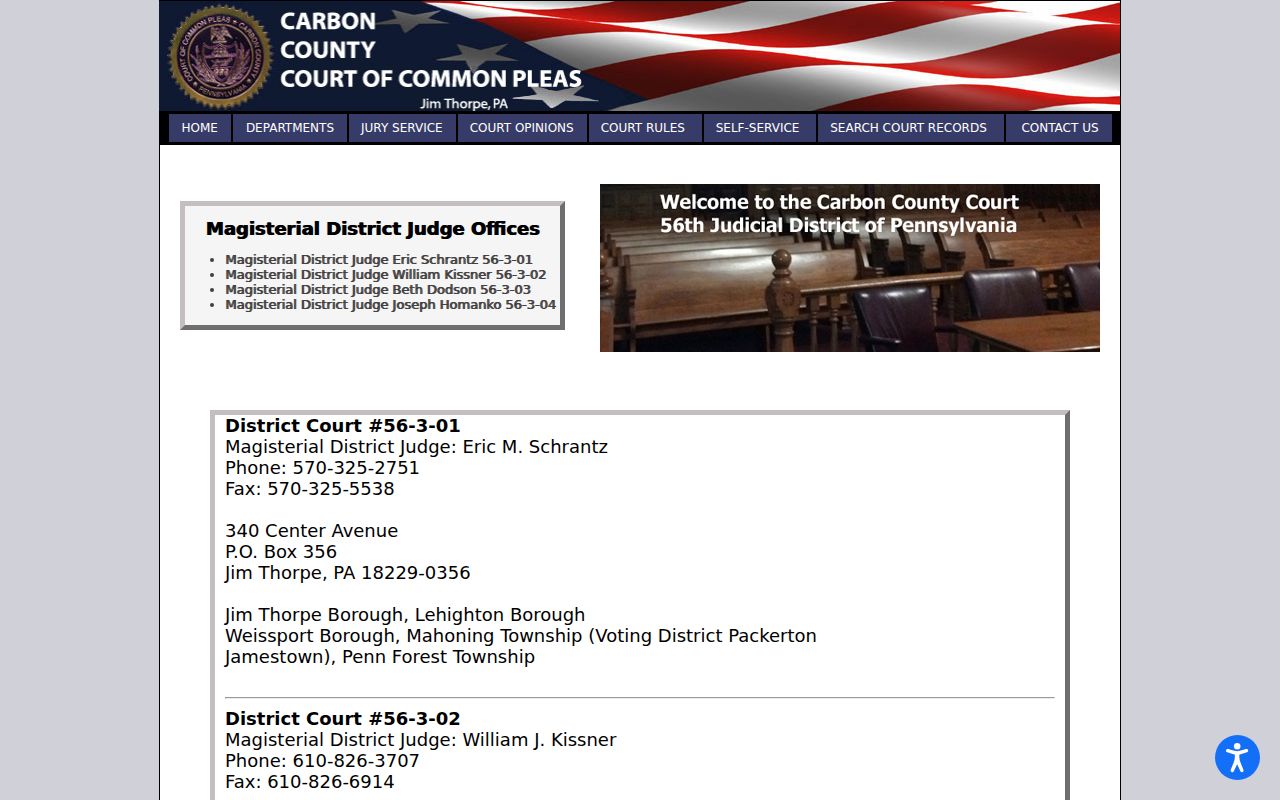
It provides the official jurisdiction map needed to contact the correct preliminary court.
How to Search Case Records
The Unified Judicial System Case Search is the broad first stop. It covers Common Pleas and magisterial district dockets. Search by participant when the docket number is unknown, then narrow the result by Carbon County, court type, filing date, or other available fields. Exact docket formats are stronger keys: Common Pleas criminal matters use CP-13-CR, while local MDJ numbers begin MJ-56301 through MJ-56304.
- Choose the Common Pleas or Magisterial District court type that matches the likely stage.
- Select Carbon County or the proper judicial district, then enter a participant name or exact docket number.
- Use a birth date or filing range only where the interface offers it. Birth dates are not tracked for every participant.
- Open the docket sheet and review charges, events, bail, disposition, and financial entries in context.
- Ask the Clerk or MDJ for an inspection, copy, or certification when the needed filing is not attached.
The official UJS Case Search help explains its controls and technical limits.
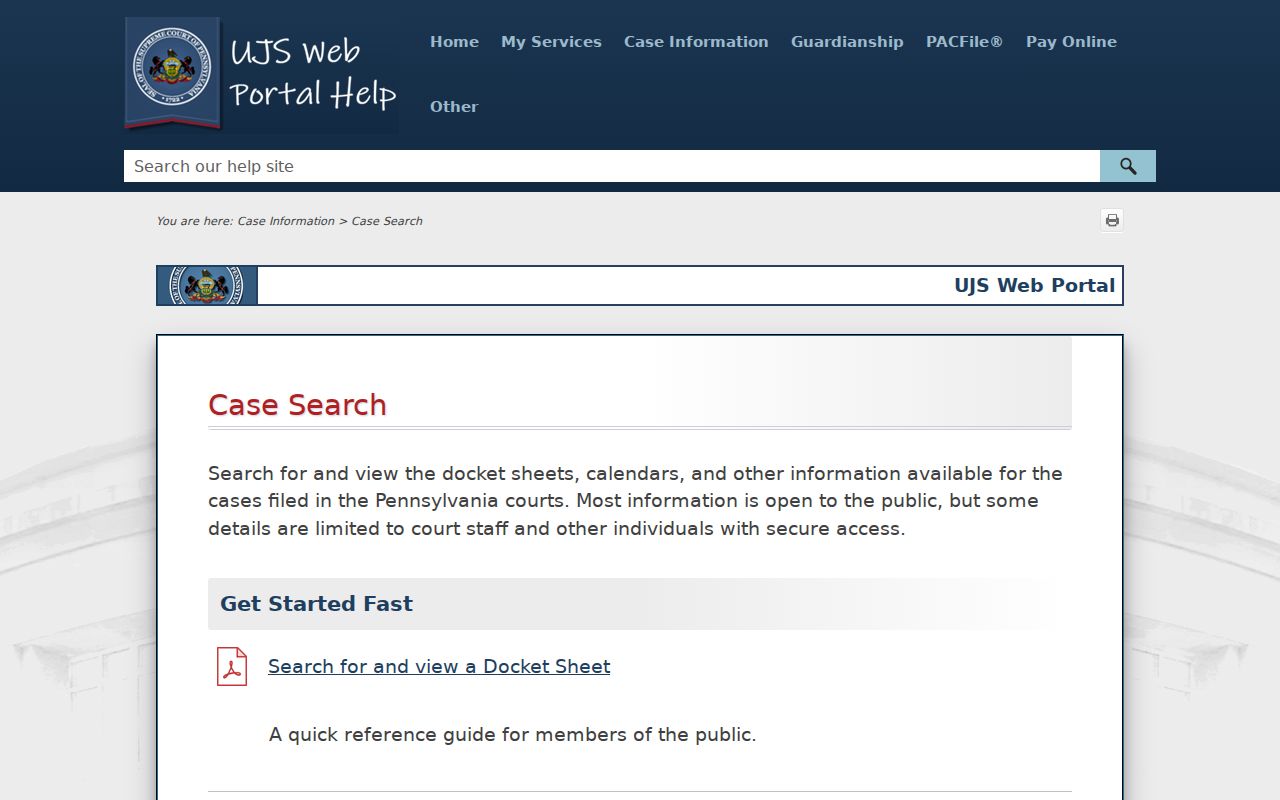
The help page matters when a docket PDF is blocked by browser settings or a search filter returns no result.
| Field | Type | Required | Use |
|---|---|---|---|
| Search Type | Dropdown or tab | Yes | Participant, docket, or organization mode |
| Court Type | Dropdown | Yes | Common Pleas or Magisterial District |
| County | Dropdown | Conditional | Select Carbon for county cases |
| Docket Number | Text | Conditional | Best exact-case key |
| Name | Text | Conditional | Participant search and narrowing |
| Date Filed | Date range | No | Limits broad results |
Carbon County Odyssey Case Search
Carbon County also provides a Tyler Odyssey public-access entry for Common Pleas records. It is a county-level parallel to UJS, not a replacement for the Clerk. The county warns that the online information is not certified for authenticity or accuracy. A critical date, charge result, or sentence should be confirmed with the original file.
Use Odyssey when a Common Pleas matter is known to be in Carbon County or when UJS is slow to reflect a county entry. If neither portal shows the case, check the relevant MDJ, ask whether access has been limited, and contact the Clerk. The official web docket can omit document images even when its event line is public. Carbon County staff can explain the request process, though they cannot give a legal opinion.
What the Case File Shows
A Carbon County court file follows formal charges rather than the whole police investigation. Read the entries in date order. One charge may be amended or withdrawn while another receives a plea or verdict. The latest disposition line is more useful than the first allegation, and a sentence line should be read with any later post-sentence order or appeal.
| Case number and court | Identifies CP-13-CR or the originating MJ district and filing year. |
|---|---|
| Charging record | Lists counts, statutory citations, grades, and the arresting agency when entered. |
| Docket entries | Dates complaints, transfers, informations, motions, orders, pleas, and verdicts. |
| Hearings and bail | May show preliminary hearing, arraignment, trial, sentencing, bail type, amount, and status. |
| Disposition | Records how each count ended and the date of that result. |
| Sentence and money | May show sentence terms plus costs, fines, restitution, payments, and balance. |
A docket sheet is not a police narrative. Anyone seeking the incident report must ask the arresting agency, subject to investigative-record restrictions.
Reading a Carbon CP-13 Docket
The CP-13 prefix points to Carbon County Common Pleas. The charge sequence keeps separate counts in order, while grade and statute columns describe how each allegation was filed. Event lines then show whether the case was scheduled, continued, resolved by plea, tried, or sentenced. Financial entries belong to the court account and do not by themselves state the outcome.
- Held for court
- The MDJ found the case should proceed to Common Pleas after preliminary proceedings.
- Information
- The formal charging document filed in Common Pleas by the prosecution.
- Disposition
- The recorded result for a count, such as dismissal, plea, acquittal, or conviction.
- Rule 600
- The Pennsylvania rule tied to prompt-trial timing; Carbon provides a local continuance form addressing it.
Secure UJS services can display material that is not part of the public view. The official secure-services page makes that access distinction clear.
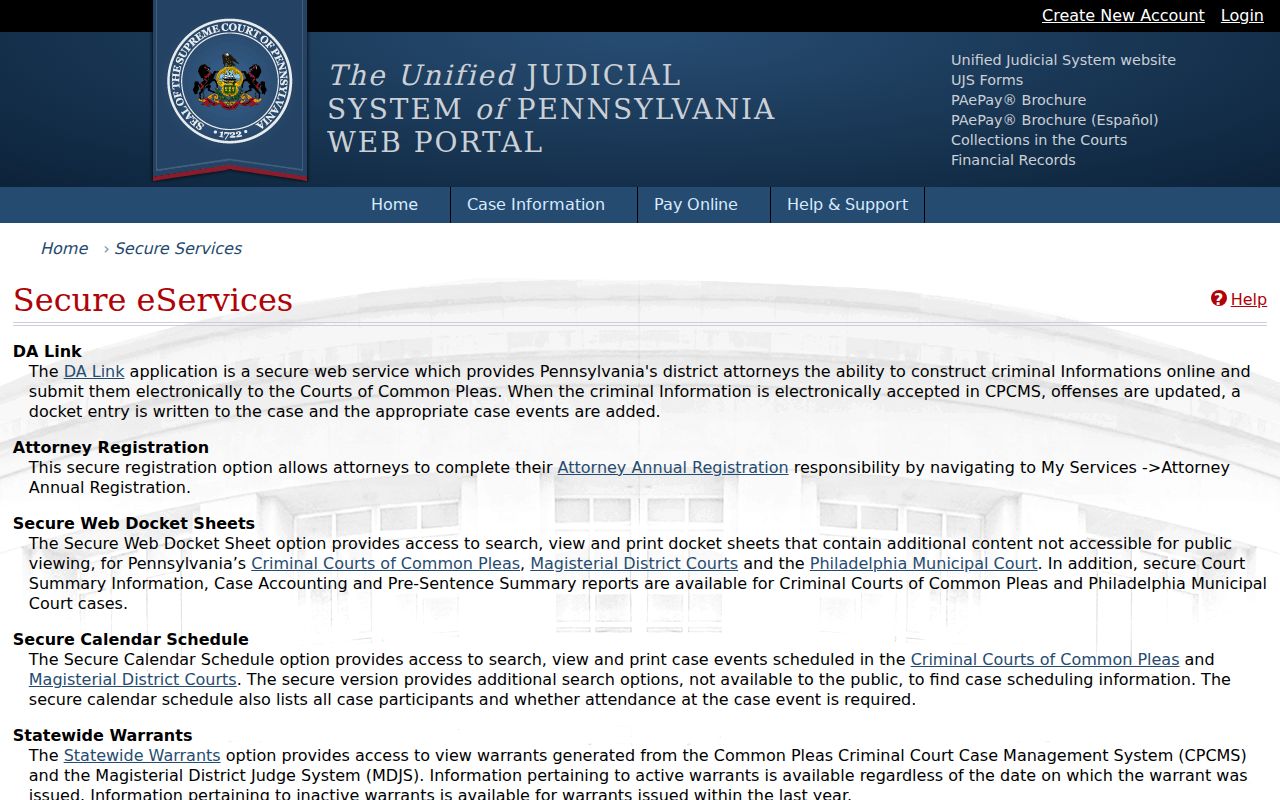
The public should not infer that a missing secure field was never recorded.
Carbon Rule 600 Continuances
Carbon Criminal Rule 106 governs continuance requests and provides a local Criminal Motion for Continuance and Rule 600 form revised for use on January 2, 2024. Rule 600 concerns the time for bringing a criminal case to trial. A public docket may show the request, an order, and a new event date without displaying the full reason in its short event label.
Carbon's Self-Service Center also requires single-sided filings. Court staff may explain procedure, but they cannot advise whether seeking a continuance is the right legal choice.
Stages of a Criminal Case
Carbon County cases move through two court levels when charges are held for trial. The MDJ receives the complaint, conducts arraignment, addresses bail, and schedules the preliminary hearing. Common Pleas then receives the case. The Clerk records the information, motions, plea or trial result, disposition, and sentence.
Case flow: Charges Filed › Arraignment › Pretrial › Plea or Trial › Disposition › Sentencing
Carbon's local criminal rules add practical detail. Rule 106 governs continuances and a Criminal Motion for Continuance/Rule 600 form revised in 2024. Rule 117 addresses warrants, preliminary arraignments, summary trials, and bail. Rule 150 covers bench warrants. Rule 576.1 governs electronic filing and service.
The Carbon County criminal rules page is the source for those local procedures.
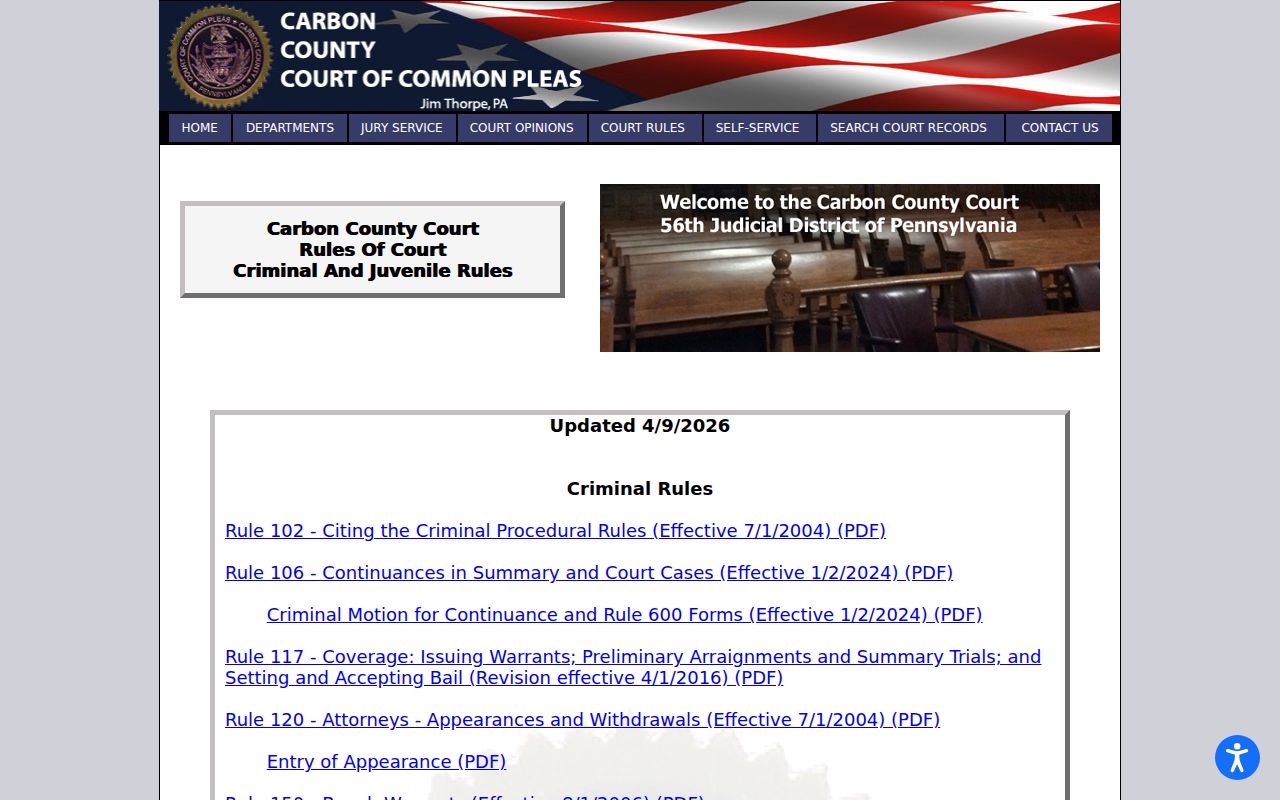
Checking the current rule and form avoids relying on a procedure used in another Pennsylvania district.
Carbon County Court Copy Fees
Online docket sheets are useful for review, but a certified or filed document comes from the custodian. Carbon County MDJ copies cost 25 cents per page. Preparation, copying, and refiling time costs $8 per quarter hour after the first free 15 minutes. Actual postage may be added, and estimated costs may be required in advance.
The Common Pleas Clerk accepts checks or money orders by mail and cash in the office. Credit or debit payment is available online or at the office kiosk. PAePay is used for fines, costs, and restitution, not as a substitute for a docket search. The Clerk returns a receipt by a self-addressed stamped envelope, by hand, or by email for portal transactions.
Access & Restrictions
Most public Carbon County criminal docket data is available under Pennsylvania court policy, but access has firm limits. Juvenile matters, sealed records, expunged cases, and Clean Slate limited-access cases do not appear in public Case Search. Personal identifiers and victim-sensitive details can be withheld. A missing case is not proof that no court event occurred.
Judicial case access follows Pennsylvania court policy. The Right-to-Know Law does not replace the judiciary's case-record system or force release of exempt criminal investigative material.
The Pennsylvania judiciary public-records forms explain the court-specific request route.
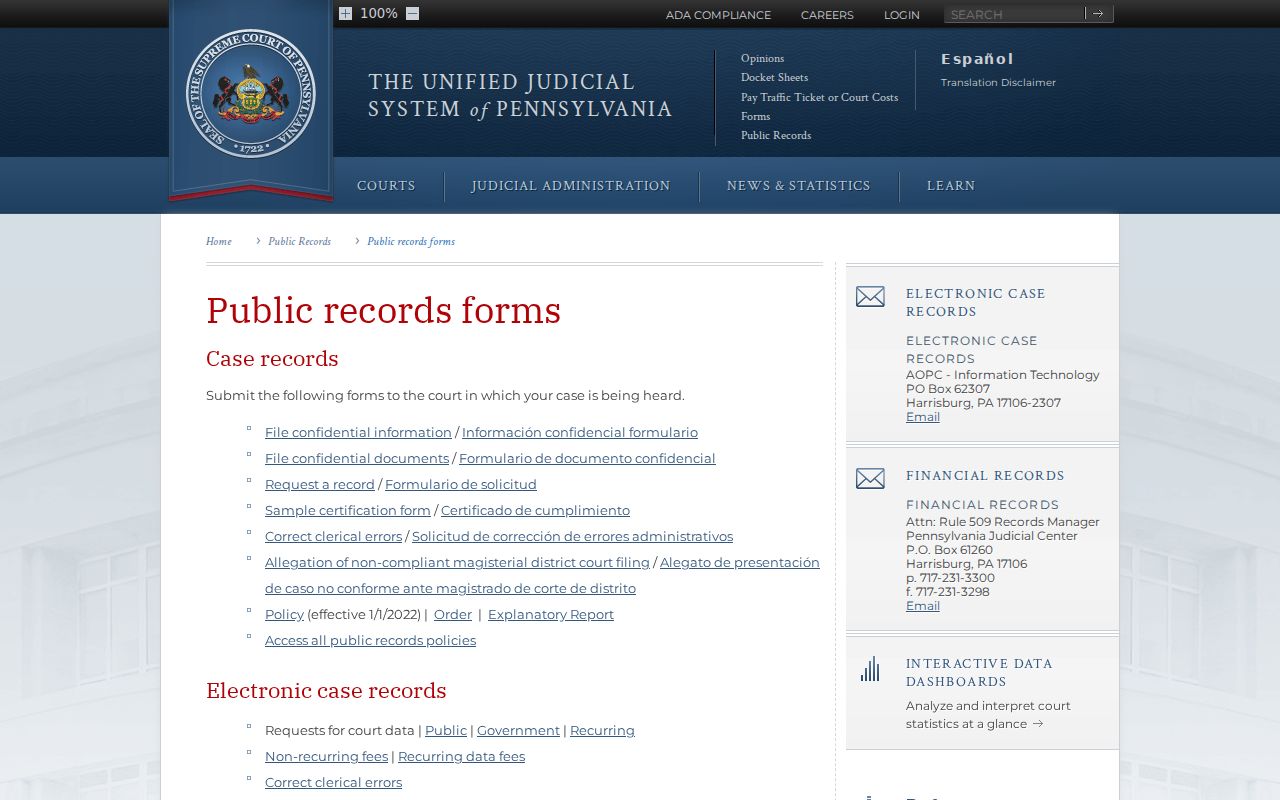
The forms help direct a request to the judicial office rather than an executive-agency RTKL officer.
Recent entries may lag. Pop-up blockers may also stop a docket report from opening. When a result should exist, retry with an exact number, check both court levels, and call the custodian. For an arrest event that has not yet become a court file, the separate Carbon County arrest history channels may identify the facility or police agency first.